

Cracking the Black Box: How Airline Pricing Algorithms Work (and How to Beat Them)
In a world where booking a flight should be easier than ever, travelers are increasingly frustrated by prices that seem to jump every time they refresh the page. For years, the internet has told you to simply clear your cookies or use a VPN to outsmart the airlines.
Let’s put the cookie myth to rest. The reality is that clearing your browser history is a superficial consumer tactic that completely ignores how airline inventory actually operates. Unless you are repeatedly querying the exact same route within a hyper-compressed timeframe (like a single hour)—which signals high purchase intent and temporarily triggers the AI’s urgency pricing mechanism to force a sale—your cookies are largely irrelevant. The true drivers dictating your airfare are always systemic: real-time supply versus demand, the historical booking curve, and the flight’s current load factor.
The truth operates on a much deeper, mathematical level. It’s not just about simple supply and demand anymore; we are entering the era of AI-driven revenue management. If you want to stop overpaying for premium flights, you need to understand exactly how airline pricing algorithms work. It is time to stop thinking like a tourist and start planning like a travel engineer.
🧠Beyond Cookies: Understanding How Airline Pricing Algorithms Work
Most travelers believe that searching in incognito tabs guarantees lower prices. But the reality is controlled by complex Revenue Management algorithms and distributed through Global Distribution Systems (GDS) like Amadeus or Sabre. The intelligence behind these systems isn’t just looking at your browser history; it’s calculating the willingness to pay for an entire route in milliseconds.
The secret that airlines protect at all costs is the structure of Fare Buckets (or Reservation Classes). An economy or business class seat doesn’t have just one price; it’s divided into specific inventory letters (Y, B, M, H, Q, etc.), each with strict fare rules and distinct price points.
Let’s look at a real-world scenario: a high-season flight from New York (JFK) to Frankfurt (FRA) scheduled for July 2026. Behind the scenes, the airline’s system has a predefined Booking Curve—a mathematical forecast of exactly how many seats should be sold by March.
If the current Load Factor (the percentage of actual seats sold) is lagging behind this historical curve, the algorithm forces the cheaper promotional Fare Buckets (like ‘O’ class) to remain open to stimulate demand. If sales are hitting the exact target, the system automatically closes the bottom tiers, shifting the baseline to mid-level fares. But if the flight is selling faster than expected, the algorithm ruthlessly blocks all discounted buckets months in advance, leaving only the most expensive full-fare buckets (like ‘Y’ class) available. This ruthless micro-adjustment happens continuously, 24/7, right up until the boarding doors close.
The airline’s algorithm crosses historical data, booking velocity, and the current load factor to dynamically open or close these buckets. If a flight is selling faster than the historical curve predicts, the system automatically closes the cheaper bucket and forces the market to buy the higher-priced tier.
🧨 The AI Layer: Fetcherr and the Personalization Controversy
While traditional GDS systems rely on basic inventory mathematics, how airline pricing algorithms work today is getting uncomfortably personal with the new generation of AI.
A prime example is the startup Fetcherr, which developed a system designed to customize flight prices based on a mix of real-time behavioral data. The goal of this technology is to find the highest price you’re specifically willing to pay—and charge you exactly that.
During recent investor calls, airline executives have openly discussed using AI to test how much a traveler might tolerate in fare increases. With an increasing percentage of domestic fares now being set by AI, the focus is shifting from simple inventory management to predictive behavioral economics.
However, deploying behavioral AI at scale introduces a massive operational bottleneck: the integration with decades-old legacy GDS infrastructure. When an AI algorithm instantly adjusts a fare based on real-time behavioral triggers, that change must propagate through heavy, fragmented systems like Amadeus or Sabre. This creates a critical “latency gap.” During this window, significant price discrepancies can appear across different booking platforms.
In some cases, legacy systems might even misinterpret the AI’s complex fare rules, leading to unintended revenue leakage for the airlines. While GDS providers are aggressively modernizing to close this synchronization gap, this temporary friction is exactly where savvy travelers can still spot pricing anomalies before the global system fully updates.
🛡️ Strategic Logistics: How to Route Around the Algorithm
Understanding this mechanic changes the game. When you realize that the base fare is a mathematical equation based on the inventory of that exact millisecond, your strategy must evolve. Once you grasp how airline pricing algorithms work, you can bypass the AI and secure the best Fare Buckets for your multi-city trips:
1. Master Advanced Routing over Direct Searches
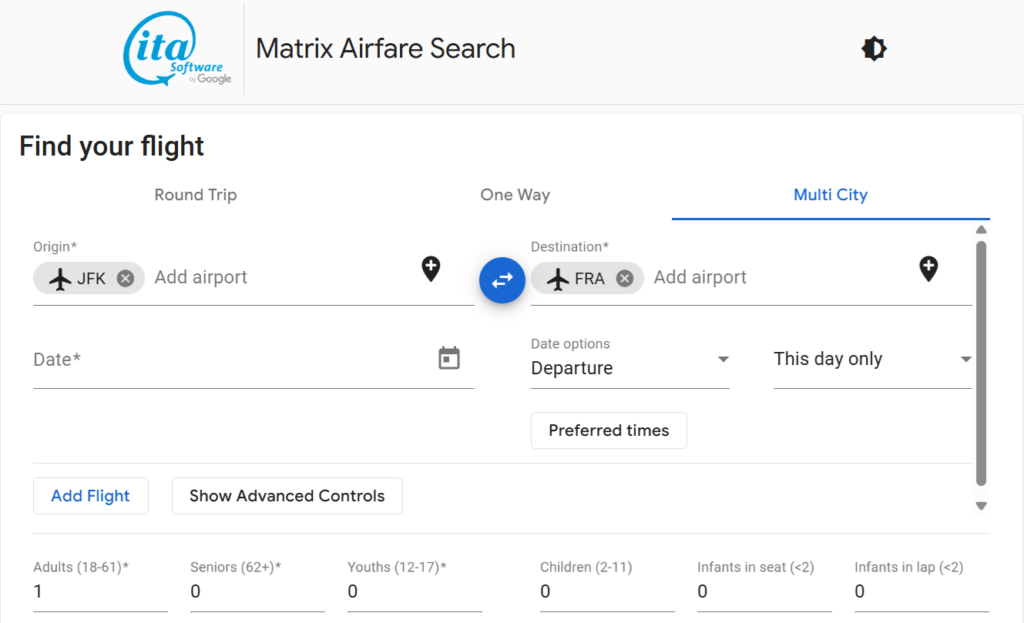
Instead of just relying on basic search engines, use advanced tools like ITA Matrix to analyze the raw fare structures. By understanding which fare buckets are open, you can construct multi-city itineraries that force the system to price using regional hubs with lower passenger taxes and lower demand.
2. Leverage Alliance Fare Breaks
AI algorithms are highly optimized to maximize revenue on direct, high-traffic routes. You can break the algorithm by exploiting airline alliance routing rules (Oneworld, SkyTeam, Star Alliance).
Consider a practical routing example within the SkyTeam alliance: a flight from New York (JFK) to Frankfurt (FRA) operated by Delta. If you search directly with Delta, their proprietary AI might quote a premium fare based on real-time dynamic demand. However, you can often book that exact same Delta metal using Air France as the Ticketing Carrier. Because these codeshare flights are governed by complex interline agreements—and the individual pricing algorithms of partner airlines are rarely synchronized in real-time—Air France may have access to a much cheaper Fare Bucket than Delta is willing to display on its own site.
This arbitrage becomes even more powerful with award flights. While Delta’s dynamic pricing engine might demand 100,000 miles for an economy seat, booking that same Delta-operated flight through Air France’s Flying Blue program could cost half the miles thanks to partner award charts. By understanding these alliance rules, you are essentially exploiting the blind spots between two isolated revenue management systems.
3. Book Smart, Not Fast
Algorithms are designed to detect urgency. Repeated rapid searches on the same route signal high intent to buy, which can trigger the system to display a higher fare bucket, assuming inventory is scarce. Plan your routing strategy offline or via third-party aggregators before executing the final search and payment on the carrier’s platform.
The Bottom Line for the Global Traveler
Now that you know exactly how airline pricing algorithms work, you understand why carriers will continue to cross legacy inventory management with cutting-edge AI.
Stop fighting the algorithm with incognito windows. Learn how to engineer your itinerary, exploit fare buckets, and take absolute control of your travel budget.
🧭 Read more: Best Cards to Earn Travel Rewards in 2025
🔗 Related Reads to How airline pricing algorithms work:
- The Ultimate Guide to RCI Travel Hacking: How I Trade My Timeshare for 5-Star Vacations
- The Perfect Stack: Combining the Best Flight Website Deals with Hotel Points for a Dream Vacation
📬 Want More Travel Hacks Like This?
Join our free newsletter and get insider tips on luxury travel for less—before the airlines change the rules again.


Pingback: Best Day to Buy Airline Tickets in 2025: Insider Tips Airlines Don’t Want You to Know - globbetrotterhacks.com