
Basic Economy Fare Bypass Strategies for the Corporate Elite
The prevailing myth in corporate travel is that once a “Basic Economy” ticket is issued via a company booking tool, the traveler is structurally locked into a “frozen” itinerary with zero elite recognition. This is a fallacy of the retail-minded. For a Flight Engineer, a restricted fare basis (such as L, G, or N) is not a dead end; it is simply a high-friction starting point that requires a specific sequence of manual overrides.
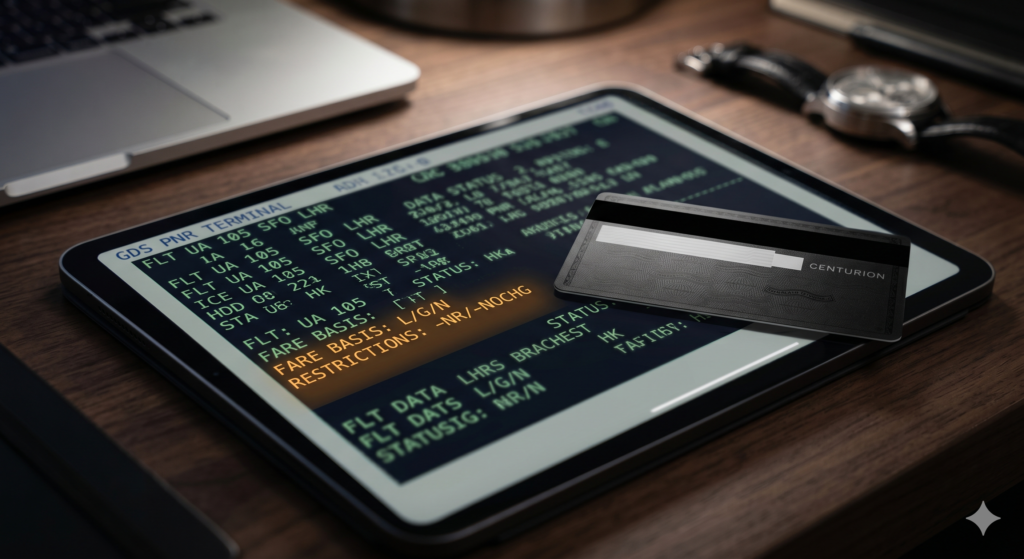
The Status Leverage Maneuver: Basic Economy Fare Bypass Strategies via Elite Desk Overrides
The primary failure of automated systems is their inability to reconcile rigid fare rules with high-value customer lifetime value (CLV). While the GDS might hard-code a -NR (Non-Refundable) or -NOCHG restriction into the e-ticket record, high-tier elite status acts as a “soft-dollar” key.
The most effective Basic Economy fare bypass strategies involve bypassing the digital interface entirely. By contacting the airline’s dedicated elite desk, a Master Flight Engineer can request a “Fare Basis Re-pricing” or a manual override of the -ER (Endorsements/Restrictions) field. While the system may block these changes, a seasoned agent has the authorization to “force-open” the PNR (Passenger Name Record) to honor elite-specific flexibility, effectively migrating the traveler from a restricted “Light” fare to a standard economy experience without triggering a corporate policy violation.
Logistical ROI: The Mathematical Case for the Out-of-Pocket Up-Fare
In the corporate ecosystem, few travelers are willing to spend personal capital to fix a company-mandated booking. However, from a logistics perspective, the ROI on a manual “Up-Fare” can be significant. When a company forces a Basic Economy ticket, they often strip the traveler of 100% of their elite qualifying metrics (PQPs or SQCs).
For an executive on the verge of retaining Diamond or 100K status, the “buy-up” algorithm—calculating the cash difference to move from an N class to a K or V class—is a small price for maintaining a global priority status that yields thousands of dollars in annual benefits. The risk control here is clear: paying the delta out-of-pocket secures the “shadow status” trajectory that the corporate mandate would otherwise terminate.
Maintaining Elite Progression Using Basic Economy Fare Bypass Strategies
Even when the fare basis remains restricted, elite members must ensure their frequent flyer number (FFN) is correctly “pushed” to the GDS after the ticket is issued. A common error is assuming the corporate tool has synced the status correctly. One of the most reliable Basic Economy fare bypass strategies is the “Delete-and-Re-Add” technique: manually removing the FFN from the reservation via the airline’s mobile app and re-adding it 24 hours before departure. This often triggers a re-synchronization of the seat map, bypassing the “paid-only” seat blocks typically associated with Basic Economy and opening the “Preferred” or “Main Cabin Extra” inventory reserved for the elite tier.
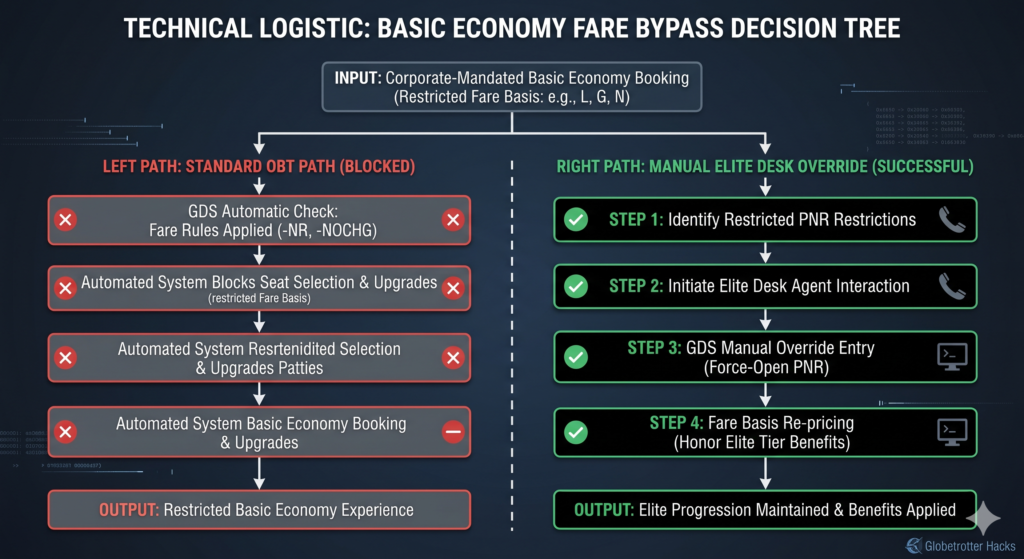
Conclusion: Actionable Logistics and Risk Control
Recovering benefits from a restricted corporate booking requires moving from a passive observer to an active logistics manager. To mitigate the risks of a “Basic Economy” mandate:
- Audit the Fare Basis: Immediately identify if your ticket is coded as
L,G, orNto know your specific constraints. - Leverage the Human Interface: Use the elite call center to request manual overrides that the corporate tool cannot perform.
- Execute Post-Purchase Buy-Ups: If elite qualification is at stake, perform a manual re-issue to a higher fare class to protect your long-term status ROI.