
Why Your Flight Schedule is a Math Error: Minimum Connection Time Risk Mitigation
There is a persistent myth in the travel industry: if an airline sells you a ticket with a 45-minute layover, it means the connection is “safe.” This is a dangerous assumption for anyone whose time is valued in thousands of dollars per hour. Airline booking systems are built for inventory turnover and competitive pricing, not for the reliability of your personal schedule.
They rely on a metric called Minimum Connection Time (MCT), which is a regulatory floor based on an airport functioning at peak efficiency. For the high-net-worth traveler, relying on these default algorithms is a fundamental failure in planning. True minimum connection time risk mitigation starts with the understanding that the system is designed to favor the airline’s efficiency over your arrival certainty.
The “Perfect Conditions” Fallacy and Minimum Connection Time Risk Mitigation
The primary flaw in any automated booking engine is that it assumes a “Nominal State.” An MCT of 60 minutes assumes that the gates are close, security lines are moving at average speeds, and your inbound aircraft arrives exactly on time. However, international hubs rarely operate under these perfect conditions. Weather, staffing shortages, or even a minor technical glitch in a terminal shuttle can turn a “legal” connection into an impossible sprint.
To achieve effective minimum connection time risk mitigation, you must account for the “Critical State”—the reality of an airport under pressure. If you are transiting through a major hub like London Heathrow or New York-JFK, the standard MCT is often too aggressive. By manually overriding the system and selecting flights that offer a buffer of 90 to 120 minutes for domestic legs, or three hours for international ones, you decouple your schedule from the airline’s fragile operational luck. You are not just buying a flight; you are buying a margin for error.
The Danger of Structural Ignorance
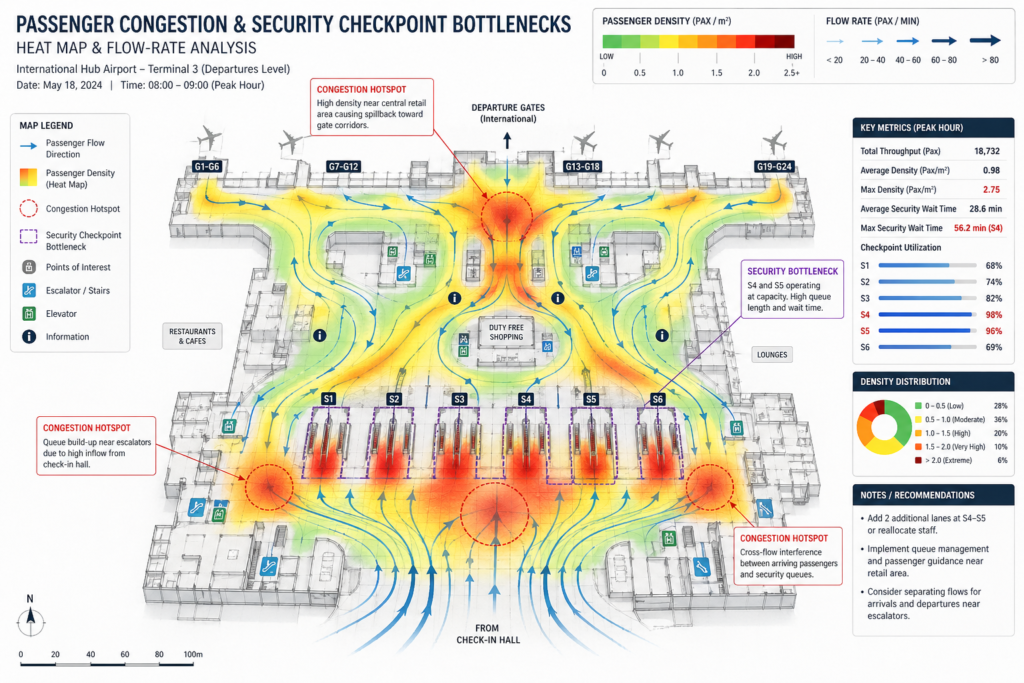
A connection is more than just a gap between two flights; it is a physical journey through a complex, often confusing architectural structure. If you do not know the layout of your connection airport, your probability of missing the next flight increases dramatically. Navigational friction—the time you lose figure out where the transit train is or which terminal handles your outbound carrier—is rarely factored into the MCT.
A 45-minute connection in an airport where you know the “shortcuts” is risky; the same connection in an unfamiliar terminal is a recipe for failure. Part of your minimum connection time risk mitigation strategy should involve a spatial audit. Understanding if your transit requires an airside-to-landside transfer or a secondary security screening is vital. If the airport structure is a mystery, a short connection is no longer a logistical plan—it is a gamble.
Leveraging Crowdsourced Intelligence Over Algorithms
While airlines rely on historical averages, real-world travelers provide real-time data. One of the most effective ways to audit a potential connection is to look past the airline’s marketing and into the “black box” of traveler feedback. Forums and platforms like Reddit offer a level of qualitative detail that no GDS or booking site can provide.
If a specific hub is currently experiencing a breakdown in biometric processing or if a certain terminal is undergoing heavy construction, those updates will appear in user forums long before the airline updates its MCT. Integrating this decentralized intelligence into your planning allows for a more accurate application of minimum connection time risk mitigation. If the consensus among frequent flyers is that a specific airport’s transit is currently a “nightmare,” the logical move is to avoid that hub entirely or force a significantly longer layover.
Manual Routing: Taking Control of the PNR
The final step in securing your itinerary is to stop using the “Simple Search” function. These tools are programmed to show the fastest and cheapest routes, which are almost always the ones with the tightest windows. To ensure your arrival, you must use “Multi-City” or “Multi-Flight” modules on carrier websites.
This approach allows you to manually stitch together a schedule that respects your risk tolerance. By choosing your own segments, you dictate the buffer. This manual engineering is the cornerstone of minimum connection time risk mitigation. It ensures that you are not at the mercy of an aggressive algorithm that values a “short total travel time” more than your actual presence at your destination.
Conclusion: Logistics Over Luck
In the world of high-stakes travel, hope is not a management strategy. Relying on an airline’s automated system to protect your schedule is an acceptance of unnecessary risk. By manually selecting longer buffers, researching the physical structure of your transit hubs, and checking real-world traveler reports, you maintain control over your most valuable asset: time. The goal of air logistics is not to find the “fastest” route, but the most resilient one.